Pura Vida 2018 A Trip to Costa Rica
Chapter One
NOV 15 Thursday
Costa Rica has been tickling in and out of my consciousness for at least thirty-five years. Back in the mid- 80’s, one of my customers at the Photo Lab was a retired Methodist minister who had spent part of his clergy career there. He loved it. In retirement, when he was invited to go back and lead mission groups, he jumped at the chance. The internet keeps showing me ads for retiring in other countries, and Costa Rica is at the top of their lists. Everyone I talk to who has been raves about the country. This is my chance, maybe my one chance to go. I can afford it, my health is good enough, and I have no other ties holding me back. My brother is a little let down because it means I will miss Thanksgiving with them, but he has celebrated most Thanksgivings without me, one more won’t hurt much. I am booked to fly out of Moline Illinois, first flight of the day. I decide it is worth a few extra dollars to spend the night before in Moline so I don’t have to get up quite so early. I am staying overnight at the Quality Inn, right across from the Airport. It’s an old building that has been re-habbed. The place was clean, if old. The desk clerk “Ria” is apparently from India. After check-in, I meet an older Indian gentleman who might be her father. He is instructing his staff as to their duties with a stern voice in that very recognizable Indian/English accent.
My flight Friday morning leaves at 0600! Ria recommends getting to the airport by 0400. Yikes. They have a “Park and Fly” service, $5/day to park my truck there. Since I’m staying tonight, tonight is free parking.
My cold still hangs on; it has been with me since Thursday a week before, with a cough producing a nasty phlegm. With all the coughing and the stress of being afraid to oversleep, I don’t get much sleep. Friday morning, my alarm goes off at 0315. It is mighty hard dragging myself out of bed. I’m tired, and this cold is getting me.
A cup of coffee and we’re off to the airport at 0405.When I first arrive, there are no gates open, though they open up shortly. I am # 3 in line to get my bags checked.
The tour company, International Expeditions, made the bookings; they got me booked into an aisle seat on all four legs of the out/back flights.
Moline to Atlanta is on a four-across regional jet. The trip to Atlanta is uneventful. I’m worried about catching the next flight; it says “International Terminal” and boarding is set to begin five minutes after my plane is scheduled to arrive. I have no idea how far away that is from my arrival gate. Turns out that it is only three gates down; less than a quarter mile and in the same terminal.
I’m at my departure gate long before they actually begin boarding. This plane is a 6-across. Atlanta to Costa Rica in 4.5 hours; “Lunch” provided. Said meal was a “turkey” sandwich- one slice turkey, one slice cheese, tiny dab mayo, three slices of cherry tomato, one tiny leaf of lettuce on something that looks more like a large, soft, soda cracker. Also included, a square of Ghirardelli chocolate, and two, count ’em two, wedges of apple. Filling, if you are a gnat. Just as well, with the cold I still don’t have an appetite.
Near the end of the flight the stews pass out customs forms- I’m grateful that the form instructions are also included in English. It is obvious the form was created in Castellano then butchered into English.
The form asks where we will be staying. Dumb me! I packed the itinerary in my checked bag and I can’t remember the name of the hotel.
We land in CR and are directed down the hallway, sky way, through a maze to Immigration, and there are HUNDREDS of people in line! This line snakes back and forth until it would make Disney proud. I can’t see the end of the line. It does keep creeping along, slowly, taking about 30-45 minutes to reach the customs officer. He isn’t happy that I don’t know where I am staying. So, I make a guess, “The Orono?” He looks pissed and puzzled, even tries to look it up on his phone. Finally, he gives up on me as too stupid to be too dangerous, stamps my passport with a little hostility, and waves me through.
Out in the baggage claim area, a woman is there holding a sign with my name. (As Brice Martin; several times during the trip I am identified as surname Martin. I finally remember that in Spanish, the mother’s maiden name is often added on. They think Martin is my surname.) The nice woman from Destination Services hands me off to a porter who picks up my bag from the carousel, never seeming to notice the backpack I’m carrying. He doesn’t know where I am going either, and is only responsible for getting me to the curb.
Outside, he is trying to figure out what to do with me while not letting on he doesn’t know. Jonathan, our guide, recognizes my name tag and flags us down. He has a bus and Victor, our driver. The trip from the AeroPuerto to the hotel (The Grano de Oro) takes half an hour. Traffic is heavy, moving slowly. Traffic laws are, shall we say, more flexible here. There are 6 lanes- 3 going our way. The lanes are fairly narrow but in good condition. Motorcycles weave through, riding the white lines, dodging pedestrians in the street. Cars and trucks change lanes like walkers on a sidewalk would, but I don’t see any wrecks.
At the hotel front desk, a pretty young woman greets me with a smile and a champagne flute of fruit juice- some combination with pineapple, I think. Jonathan Seguiero, our guide, tells me there is a lot of pineapple grown here, also bananas and coffee. On our way, he points out coffee plants. Jonathan has his doctorate in medicinal plants of the tropical rain forest. He turns out to be an excellent birder, also.
He tells me that his oldest son, age 17, is studying a year in Japan. He is fluent in Japanese as well as English and Spanish, and wants to study a year in Russia to pick up that language, as well. I feel such a dolt, can barely manage English.
It is a lovely room! Tidy, well decorated and well appointed. And with a front wall full of windows onto a main hallway.
The group officially meets up tomorrow morning, so tonight I dine alone at the Grand restaurant in the hotel. It is uber-fancy. The place setting includes three forks (dessert fork at 12 O’clock), linen napkins, etc. Fancy menu. Forgot my phone in the room, so no photo of an overly elaborate plating of my entree. The food was good: intense flavors, decent portions, not too much. I’m sure this qualifies as very high-priced dining. It’s nicer than the Drake, more like Martini’s. I have a beer, entree, and tres leches for dessert- total with tip, US $35.
The sheets on the bed are tucked in so tightly I can barely pull them out. Luxurious bedding for a great night’s sleep. After supper, I make espresso in my room, single-use pods. It was strong, foamy and sweet.
By the way, from the airport to the hotel, everyone we encounter speaks very good English. Signs and menus also include English.
Chapter Two
Saturday, Nov 16
First Full day in Costa Rica. Over Breakfast (Desayuna)in the hotel restaurant, I meet the others. The other Iowan is Ruth, a retired MD of about Seventy. She has traveled all over. She is an enthusiastic hoot, bubbly personality, great conversationalist, lots of stories about her travels. Also at Desayuna, Joe and Nancy Bonita and Lloyd and Mary Edwards of Colorado. They know each other.
The couple I saw at dinner last night, Nick and Julie Van Egmond are from California, they are late 40’s. She’s a veterinarian. This is not their first trip, either. I am the only newbie; everyone else has been on many similar trips, some of them with our guide on a trip to Cuba.
One more couple for our group missed a flight, will be joining us later today.
The first part of our day is a long bus ride over the continental divide, through cloud forest to the region of the Serapiqui River.
We arrive at the Pozo Azul, where Mary, Ruth, and I go for a two-hour horseback ride. It’s a great way to see birds, covering much more ground than we could on foot. Because they have had so much rain, everywhere we go is very muddy; the horses sometimes are negotiating knee deep mud. The horses take it no problem, but there is no motor vehicle that could have gone where we went with nearly as much ease.
From there to lunch at LaSelva Biological Station. After lunch, a 90-minute hike through the edge of a tropical rain forest. We saw lots of birds, peccaries, millipedes, army ants, bullet ants, leaf-cutter ants, loads of plants including cacao (the plant for chocolate), limes, guava, and much more. It would have been a great idea to take an identifying guidebook and a notebook to write down all these names. By the time I get back to the hotel to write notes, I have forgotten many of their names.
Tonight, we are staying at LaQuinta Inn. Accommodations are rustic cabins but there is fresh paint and decent facilities. There are a pair of water glasses, but no coffee maker, also no clock, or TV. Twin beds, a sleeping porch with a hammock, (curtains but no screens). At 6pm it is still very warm and humid; hoping it will cool off at night, I think about maybe sleeping out there, swinging in a hammock in the tropical breeze. They gave us lists of animals we might see to keep track. I mark at least eleven birds, a frog, a lizard, an iguana, long-nosed bats, and a peck of peccaries. It’s then I notice that the list also contains “Vampire Bats” on the list of animals we might see. That changes my thinking about sleeping outside where there are no screens.
Looks like I got a little red from the sun though we were in cloud cover or rain all day. I’ll have to remember that we are only ten degrees from the equator; much more sun than Iowa sees.
Supper will be at 7pm, we will sit together.
Just as all of us are getting checked in, the missing couple arrive, Phil and Mary Jo; 27 hours later than expected.
As we travel through the countryside, I notice the houses. Most are very small, mostly made of concrete block materials with tin roofs. Most have a covered place to sit outside sheltered from the rain. Most of the windows do not have screens, almost every one of them surrounded by a high fence or wall. Frequently there is a tap in the front yard, I wonder about indoor plumbing; many have a satellite dish on the roof.
It’s a good thing to have a very experienced horse when the rider doesn’t know what he is doing.
#
Chapter Three
Sunday, November 18
The sun comes up here around 0600; morning twilight arrives before 0530. La Quinta staff put out pieces of fruit for the birds. I’m up and out at 0530, watching the many birds, a dozen of them or more at any time. Among them I see the national bird of Costa Rica, the clay-colored robin, also a Baltimore Oriole (on vacation, one expects), blue honey creeper, and a hummingbird.
After breakfast, we go to the organic farm of Don Daniel and Dona Maria. (Don and Dona are not first names, they are honorifics, like Mr. and Mrs. Our guide treats them with genuine respect). They have ten hectares (just under 25 acres), and are working toward having it be a certified organic farm to grow vanilla and black pepper. They also have 5-10 pigs, some piglets, and hens, and some banana trees.
They use the manure (“caca”) from the pigs and chickens, mix it with ashes and shredded wood to make compost which they apply to their own crops and sell to their neighbors.
Don Daniel shows us his compost making operation. He mixes pig manure (which is in shredded wood used for bedding), chicken manure, ashes and charcoal from the kitchen, a crushed volcanic mineral with the texture of gravel, (for potassium), and molasses from cane he grows. The ashes were a surprise, but he adds them because the pH of the soil here is 4.5 -5.0, quite acidic. The ashes help to raise the pH to a more neutral level, which the plants appreciate.
His practice is to let each manure dry separately in a tin-roofed shed out of the rain for 22 days, then mix all the ingredients together and it is ready to use in one day.
We walk over Don Daniel’s acreage, it is very steep. There are trenches along the contour lines to control erosion. It rains on and off, the ground is muddy and slick in spots.
Vanilla is an orchid; someone mentions it is the only edible orchid, and looks like a vine. Pepper is also a vine. Both are grown on trees planted especially for the purpose. At a certain point in the year, the trees used are pruned of almost all branches. The branches allow for shade during part of the growing season, which both pepper and vanilla require. The trees sprout new branches for the next cycle.
Daniels’ farm has produced a black pepper crop for three years, enough to live on. Last year was his first vanilla crop. A buyer came from North Carolina to buy the vanilla, gave him $100/ kilo for the three kilos he produced. Next year he hopes for 300 kilos of production, and perhaps as much as $300/ kilo for the undried pods.
After touring the farm, Dona Maria and her youngest daughter feed us lunch: black beans, white rice, tomatoes and cucumbers, sautéed squash, chicken, and fried plantains, plus tamarind juice. It was all yummy. Their home is simple; the kitchen area is open-air, under the roof with a tile floor.
They offer some of their pepper for sale. I bought a four-ounce bottle of ground white pepper for $5. It might be slightly less expensive at HyVee, but I know the source of this, and much more of the profit goes to the farmer; a bargain.
After lunch, a two-hour bus ride to get to the boat to take us to Tortuguero. The landing where we will catch the boat has a restaurant and bar. They charge a dollar to use the restroom (banos). Seems steep, but I’m sure otherwise they would have tons of people only using the restrooms and doing no business with them. They have to make a living somehow. This is the only place we are asked to pay for use of the restroom.
Depending on the desperation of one’s bladder, a bargain. Again, a small way for American touristas to support the eco-tourism economy.
It’s about eighteen feet long, a narrow-jon boat style with an inboard motor, covered with a wooden roof and plastic side curtains, seats about forty people. The river to the lake is a narrow and twisting channel, a fair number of these boats plying back and forth. Usually, they slow down at the turns and when meeting other boats, though one passing driver did not. His wake baptized four or five passengers in our boat and shipped a few gallons of water. My rain jacket, sitting at my feet, got wet, but no water on me.
There are no roads into Tortuguero; you arrive here by boat or plane. We arrive by boat and will leave by air.
There is a proposal to bring in a road, to include a bridge across the river from the rain forest to the village of Tortuguero, but the locals seem to oppose it almost unanimously. It would irrevocably change the area; more tourists, but also more people would change their way of life.
The Evergreen resort (I am in room # 33), is very nice– it is more rustic than LaQuinta, there is no Air Conditioning. This is the Caribbean tropics; it is hot and humid, with lots of rain and very little breeze. Since we are deep in the trees; the day is rainy, warm and humid, but the temperature cools down in the night. It is a big place, there lots of others here. In the afternoon, around 5pm, after a long day, I was lying down, resting before supper, and hear music. There is a 3-piece band down by the bar and pool, playing mainly calypso music for around 50-60 people. (This is the Caribbean, after all). The band plays until around 5:30pm.
Supper is at 7pm; simple but scrumptious, served buffet style– white rice, beef and brown gravy (very American in taste), steamed carrots and something root-like; all very good. And Flan for dessert!
#
Chapter Four
Monday, November 19
The windows in my room have only screens, no window glass, so I am perfectly situated to hear the first cloud of tourists at 5:18 am as they come on their way to breakfast; loud like a flock of parrots. Breakfast for us was not until 7am. Getting dressed after showering, I discover I can’t find my “International Expeditions” cap. Too bad, that was a nice cap, and a keeper souvenir; plus, it’s raining. I’m going to need a cap. Ah well. Best I can come up with is that I set the cap down on the table when we arrived and then left it on the table.
Breakfast includes “gallo pinto” (black beans and rice), little vienna-like sausages, omelets or eggs cooked to order, and croissants; one with meat stuffing, another with fruit preserves. There is also orange juice, and the most luscious pineapples and papayas. And, of course, coffee. One of our group asks for Decaf coffee. The waiter looked offended. “We don’t have that here.”
It is raining hard when we begin the morning excursion by open boat into the river through the tropical rain forest. It is the same kind of narrow jon boat we had yesterday, except it doesn’t have a roof. Thankfully, the captain provides ponchos. Still, a cap would have been a great boon.
We see so many birds! Jacama, lesser blue heron, anhinga (like a cormorant), a heron with red eyes. We also see the gold-beaded eyes of a caiman, floating just at the surface. After two hours of very heavy rainfall, we give up and return. I am soaked; every bit of clothing I have on wrings water. I squeeze out all I can get to drip away and hang it up, but with this continuing rain and no a/c, it is not going to dry.
After lunch, we take a second boat ride into another section of the park. It is still raining, sometimes hard. This time, only Nick and Julie, Ruth and I brave the rain for the trip; the others stay behind.
We saw more birds, especially the Great Kisskidee and a very close up Great Egret. In one of the rivers, the water is black like flowing tar, shiny from tannins in the water.
#
Chapter Five
Tuesday, November 20
Another packed day with incredible contrasts. At breakfast, Nick and Julie come in bringing an extra cap. They have brought their own headgear, so Nick gives his IE cap to me. Made my day! After breakfast, we boat over from Evergreen Lodge to the village of Tortuguero, a settlement of some 1,200 souls on the 200-meter-wide barrier island between the River and the Caribbean.
It was raining when we arrived, (of course), and for the first half hour of our tour. The village is laid out along one twenty-foot wide paved foot-path. Almost every lot along “Main Street” has been converted to retail. According to our guide, virtually everyone in this village depends on tourism directly or indirectly.
One place, Casa Marbella, looked interesting so I asked for a business card. The owner gave me a tour, showing me the rooms ($40/night, single), including breakfast. At the end of the tour, he asked me where I was from. “Iowa,” I answered.
He said, “I’ve been to Iowa; to Storm Lake where I gave a talk at the Buena Vista University.”
I asked when he had been there.
“May or June” he answered.
“Ah well then,” I said, “You should come back in February to see what winter is like.”
“Well,” he said, “I’m originally from Ottawa Canada.”
I did get to walk on the Caribbean beach for a way, watch the Caribbean Sea roll in angry and gray today, wearing an aggressive gray watch cap of rain clouds.
Back to the hotel for checkout. Two days of wet cotton T-shirts have become a mold factory; the stink grows. All the wet stuff goes into the backpack.
We are to fly out from the village air-strip; emphasize “Strip.” It is paved, but there are no facilities other than an abandoned building where we can huddle under the roof overhang from the rain.
Sansa Airlines’ airport manager, “Alex” went sloth-like through our list- the ten of us plus Jonathan our guide, plus another group of 9. Alex meticulously weighs each of us wearing our carry-on backpack. Then he weighs each of our checked bags by holding each bag while he stands on a bathroom scale.
No plane that comes to this strip is large enough for all of us and all our luggage; there will be two planes. The first plane arrives and swivels to a stop at our end of the strip. It is a Cessna. It has a pilot, co-pilot and seats for 20 passengers. The first plane gets the other group, plus our guide. After some figuring, they also come and get two more of our ‘checked’ bags. They load up, fire up the single propeller, and off they go.
About ten minutes later, an identical second plane arrives for us. There is no breeze at all, but our pilot taxis to the far end of the strip, practices revving the engine while he is turning around, and then sets off down the runway.
The flight is about 25 minutes, mostly we are deep in the clouds with no visibility. In the few breaks we can see extensive pineapple plantations, thousands of acres of industrial, high input, intensive agriculture.
Preparing this land and spraying the chemicals was the work Don Daniel did in the past and is now atoning for with his organic farm.
From the airstrip in Arenal, we go to Casona Rio Fortuna, the Hacienda of Elieth Herrera. This is a heritage plantation, once owned by a President of the country. The Herrera’s have owned this place for ten years. On our arrival they offered us a sip of the best rum I have ever tasted. It was sweet, cinnamon-spicy, hot, and yummy
They sang to us, making each one of us feel as if she was singing personally to each one of us. They fed us home-style, good food on wooden plates topped with banana leaves.
After lunch we were given a tour of the farm. We saw the kitchen herb garden, a sample sugar cane field and a trapiche, (the pressing mill for the cane) run by two young oxen. We tasted the raw juice, sweet, and the block of molasses/brown sugar product called ‘dulce.’
After the hacienda, we repair to the Arenal Hot Springs Resort and Spa. Wow. This is worlds apart from the Evergreen lodge. As every other hotel we visit, they meet us with fresh juice; here, they also offered a damp towel with refreshing scent. Very fancy rooms. Here, the room ‘key’ is a proximity card, which must be inserted into a slot near the door to activate the lights. Took me a few minutes to sort that out; finally had to resort to reading the information provided to us at check in. Each ‘room’ is a duplex cabin.
A quick change and we are off to the Ecotermales at Fortunas, a big hot springs resort. There are multiple pools, each at different temperatures. Delightful. I could have stayed in that pool for weeks. We eat our supper here in their restaurant, then back to the resort and our rooms by 8:30pm.
#
Chapter Six
Wednesday, November 21
Today we tour the Danaus nature area, seeing countless birds, plus a two-toed sloth and her baby, an agouti, as well as bromeliads and a bunch of orchids.
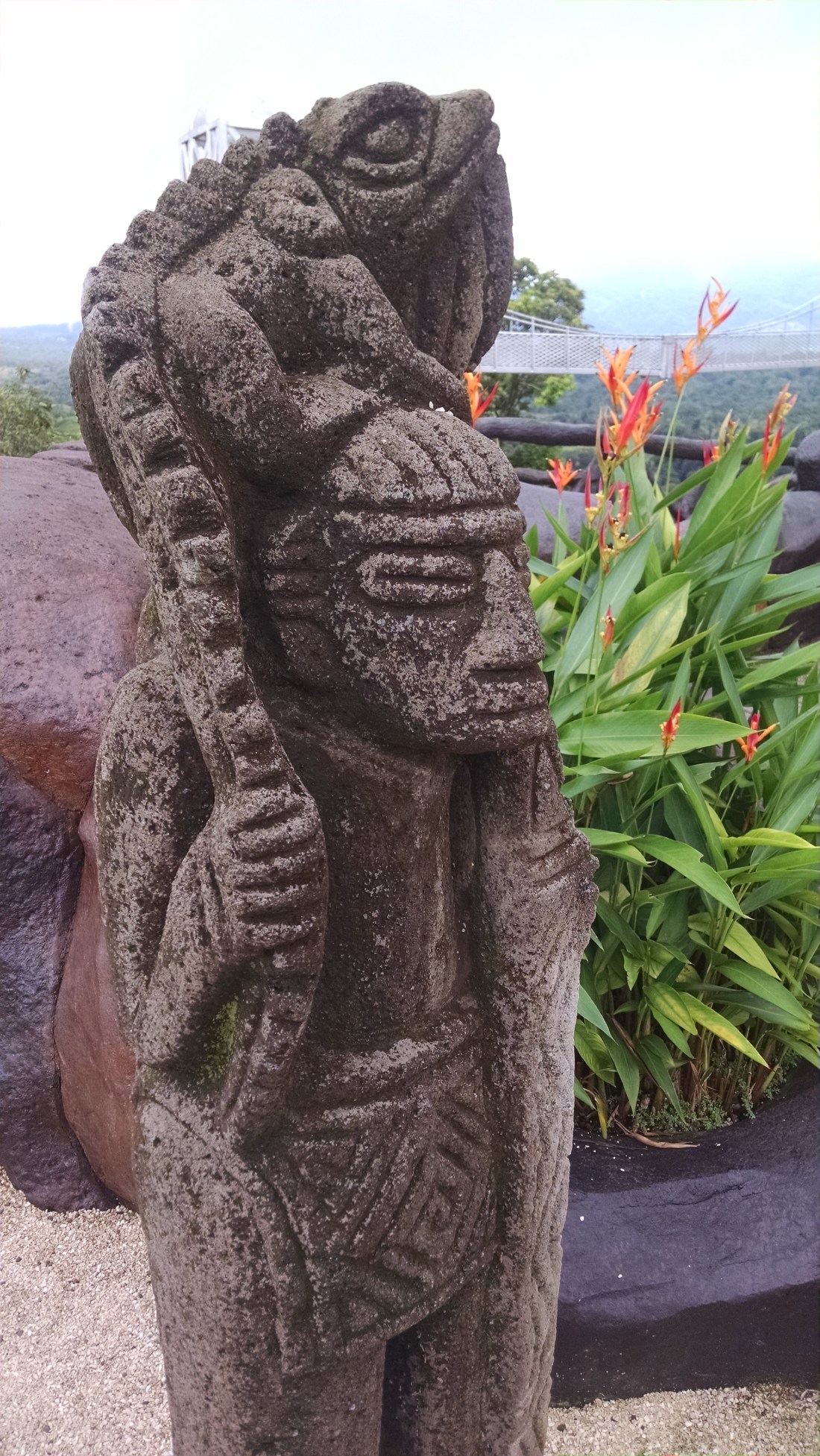
Here we were treated to a demonstration and talk by a member of the Maleku tribe, an indigenous tribe on the border between Costa Rica and Nicaragua. Due to various pressures, there are now only about 650 tribe members left, and at this point, they are so inter-related that marriages are problematic. We are introduced to their hand-carved masks and bowls.
Lunch today at Mi Casa restaurant in the town of Rio Fortuna. Several of our group had hamburgers and French fries. It looked good, I had to admit. Instead, I stayed with the local cuisine and had rice and shrimp, which came with a small salad and fries.
After lunch, to the hanging bridges, a 5 km walk up and down steep terrain, across five or six hanging bridges. Mary Jo, frailest of our group often uses trekking poles and has difficulty getting on and off the bus, was game, but just couldn’t navigate the steep terrain. Our guide urged her to get as far as the first hanging bridge, then go back the way they came.
Supper tonight was at Rancho Perla. Our guide has known Chef Perla for many years. Supper was Old World Class. I had chicken breast and shrimp and mushrooms in a garlic wine sauce over mashed potatoes and vegetables (broccoli, cauliflower, carrot, and onion). Everything was scrumptious times infinity! The sauce was heavenly, the potatoes with garlic perfectly seasoned. The portion was he-manly, meaning it would have been plenty for two. I ate and ate, much more than I needed, enough to be afraid indigestion would keep me, but it was so good I couldn’t stop eating. To my happy amazement, my tummy stayed happy, no late-night indigestion at all.
Tomorrow morning, we have an early start. Our instructions are to have our bags at the door ready to go at 0630. The logistics are complex… for the tour company, not for me. Our driver, Victor picks up the bags (early). He will drive on ahead. We take a separate vehicle to the lake, where a boat takes us across, where we are met by a third vehicle which will takes us to “Don Juan’s” Coffee Farm in MonteVerde. Don Victor meets us at our night’s hotel with our bags.
#
Chapter Seven
Thursday, November 22. Thanksgiving Day
Jonathan and Victor collect our luggage from our rooms at 0630. We eat our breakfast at 0700. At 0800, we board a 13- passenger van for the trip to the lake landing. Back across the lake- moving slowly along the shore for the first part. We saw cormorants, a bunch of them, perched in the trees together. On one tree, an osprey perched high above them. They didn’t seem perturbed by them. I guess he is not a threat to them.
In a tree by the shore, a black Tayra, a member of the weasel family. Our guide says he is rare to see.
The boat landing was very basic; no permanent structure visible; no concrete ramp, etc. A rutted dirt road leads to the water level. Our third van meets us there. An hour and a half to two hours van ride from the landing to Don Juan’s Coffee Farm. This trip up the mountain to the Cloud forest town of Santa Elena takes us up a very steep, very rutted, twisting road. In most places, the road is not wide enough for two vehicles to pass. The drivers finagle and juggle to get around each other; it reminds me of the way pedestrians negotiate passing around each other on a sidewalk.
Don Juan’s coffee plantation has a nice restaurant and, of course, a gift shop. They sell coffee and chocolate, including the chocolate nibs: the best product finished chocolate before the cocoa powder and cocoa butter are separated.
The tour guide shows us all the stages of the process of raising coffee, from planting the seeds in the nursery beds, transferring the plants to containers, then transplanting the saplings in the field. It is three years from transplanting to first crop. The trees then may produce for a hundred years.
The coffee fruits don’t all ripen at the same time; pickers pick only the ripe fruits. Obviously, has to be picked by hand. Harvest season extends over a two-month period. Pickers are paid Two dollars for a one-cubic foot box full. Experienced pickers may pick fifteen or more boxes per day.
By Costa Rican law, only Arabica coffee plants may be grown in CR. This species produces the best quality coffee, though not the largest quantity. The country leaders restricting production so the country may earn the best reputation for its product.
We see the seeds (the coffee bean) removed from the fruit, then laid out to dry in covered patios. When dry, they are ready to ship. After roasting, the beans begin to lose quality, so roasting at the destination produces the best quality coffee.
They ‘roasted’ some coffee beans for us (in a dry cast iron skillet), then took the roasted beans, ground them and let them steep loose in hot water for two to three minutes. When the coffee is ready, they filter out the grounds through a cotton bag that looked a lot like a sock.
Next was a display of sugar cane. The mill apparatus which squeezes out the cane juice is called a “trapiche.” This term becomes used for the entire set up, mill and the shed where the work is done. The raw cane juice is sweet, though not overly so, with a ‘green’ taste, not unpleasant at all. We are encouraged to try chewing a bit of the pith inside the cane.
Then it is on to the Chocolate demonstration. The cacao fruits have their seeds inside a mucilaginous coating. After removing the seeds from the fruit, it is allowed to ferment for five days, then dried and roasted.
The roasted seeds are cracked into small pieces called “nibs.” When these are ground, they contain both the cocoa powder and cocoa butter. The guide mixed nibs with vanilla extract, salt, brown sugar, and chili powder to make the “Drink of the Gods,” Each of us were given an ounce to eat. It has a very intense chocolate flavor, the heat of the chili powder intensifying the flavor. Then, he took some of that mixture in hot water, and gave us this to drink. Best hot chocolate ever!
Lunch was at Don Juan’s, then to the hotel at El Establo. This place is fancy, with balcony views of the mountains. There is no air conditioning, not even any fans. It is warm in the afternoon, but after the sun goes down, it cools off very comfortably. After about an hour to rest, we are driven to the house of Marvin Rockwell, one of the remaining original 44 Quakers who came to Costa Rica in 1951 in protest of the American Draft Law.
Marvin is 96 now but still has a sharp mind and engaging wit. He loved telling us the story of the community, of their journey from Fairhope, Alabama to this cloud forest. When the community established here, there were no roads. They discussed what they could do to earn a living for the community. The soil and climate were good for growing, but access to markets was a problem. They decided to establish a cheese factory. If it takes a while to get cheese to the market, it is just better aged.
We also met Marvin’s wife, Flori. She is eighteen years his junior, a native of Alajuela. They still seem much in love. When we left, she gave each of us a warm hug. Marvin is such a treasure! This important story of faith and response by a Quaker community committed to peace, solving problems together.
#
Chapter Eight
Friday November 23
Today is a bit of a downer, realizing today is my last day in Costa Rica. My Saturday evening flight leaves at 0815, which means I need to leave the hotel at 0515, and will miss the rest of the group touring San Jose. Ah well. If everything goes all right, I should be back in Moline by 4pm.
For my last full day, I’m up at 0530, watching the sun come up. There is a gentle breeze, and I even see a bit of blue sky, the first sunshine since leaving San Jose. We have been in a rain forest, after all. Some of the clouds have dark underbellies suggesting they are carrying a load of rain, but the sky is just about half clear. Each section of blue sky is a different shade of blue. Some wispy clouds like the mussed up white hair of a happy old man.
Off in the distance, I can see the Pacific Ocean. Air over there has a light haze.
On this Black Friday, my last day in Costa Rica, we start the day at a forest educational area. There are steep trails. My legs are aching. I’m not accustomed to so much walking. That’s my fault, isn’t it? I should have spent the months before training.
Mary Jo, the frailest member of our group totters along with two trekking poles. I get frustrated with her for going so slow, but if it weren’t her, the group would be waiting on me.
We see a palm viper curled up in the branch of a tree, just about belly height, looking like someone curled a green rope around a tree crotch. It does not move as we gather around to takes its photo. I understand it is poisonous.
There is a hummingbird feeding station with half a dozen feeders, attended by more birds than I can count. Our guide names them all, but I can’t keep them all straight and quickly forget their names. On my next birding trip, I need to bring a book for ID and a note book to write them down. There has been a little bit of camera-lust in me for the lovely cameras and impressive lenses some of them have. My phone and small camera are not enough for good wildlife pics.
After this, another butterfly garden- a guided tour this time, led by a recent Master’s grad from Kansas State U. This garden had three enclosures, set up to represent three climate zones we have been in: coastal, mid, and cloud forest.
After Lunch, the three hour drive back to San Jose. The roads especially in the mountains are gasp-producing. Our driver Victor expertly negotiates passing and being passed. Traffic rules are, “flexible.” So far though, I haven’t seen any evidence of road rage.
Our trip down to San Jose eventually takes us for a short while on the Pan American Highway and the Pacific Coast Highway. These roads are paved (macadam), not as twisty, and a bit wider.
#
Chapter Nine
Saturday, November 24
The return trip
To catch my 0815 flight, I leave the hotel about 0500. Driver Victor gave me a hug as a sendoff. He and our guide seem to genuinely enjoy their work.
Not paying attention, I get into the line to check in at United. Fortunately for me, there isn’t a line yet, so it only takes me a minute to get to the gate agent, where we discover I should be at Delta.
At the entrance to the gate lines, security police engage me in friendly conversation. “Where did you go?” etc. They are screening, and it is very well done; identifying potential problems without being surly or accusatory about it.
Bag checked, boarding passes printed, and I’m on my way to Security. Not too busy this time of the morning. It does take me two trips through the metal detector. My belt buckle sets off the alarm here; has not set off other metal detectors. Even with that delay, I am through Security in four minutes. It is 0545, the plane boards beginning shortly after seven, scheduled for takeoff at 0815.
In the airport, the path to All Gates leads inescapably through the Duty-Free Gift Shop. This path, in fact, is not even a straight line, but one must weave through the goods on offer. Prices in the airport seemed typical for Airport Gift Shops. A Costa Rica soccer jersey $32.95. Also for sale, in the liquor area, “Hennessey” whiskey for sale. Not a product of Costa Rica.
The flight from San Jose to Atlanta lasts a little over four hours, no problems. We land in Atlanta about 1300, (Eastern Time Zone). Costa Rica is in Central Time. San Jose is almost due south of Dallas, Texas.
In Atlanta, back again in the USA, we have to pick up our bags from one area, then load them onto another baggage area. I breeze through customs, no waiting, not even a wait for an agent; must have gone through in less than a minute. Now, back through TSA screening, also quick.
There is time for a ‘leisurely’ lunch. I choose The Grind House (it was just OK). First burger I’ve had in over a week, back at the gate at 1430. The flight is scheduled to leave at 1545. I notice there is no airplane at the gate.
Sitting in the somewhat crowded gate area, the lady seated next to me says, “Are you ready for the snow?” “What? I’ve been in Costa Rica all week; it hasn’t been below 70 the whole time.”
“Well,” she says, “Welcome back to Iowa.”
Checking the weather on my phone, it appears the prediction is for 6-8″ of snow in both Burlington and Moline, beginning Saturday evening into Sunday. It that is the case, maybe a change of plans is called for. Instead of staying over in Moline Saturday night, I think maybe I need to go back to Burlington tonight ahead of the snow.
After a few minutes, a grumpy-looking man in the next row of seats says, “Now THIS flight is delayed. I’ve been here eight hours. I missed my flight because I was one minute late.”
The announcement by the gate attendant confirms the flight is delayed; due, she says, to a delayed plane arrival from Louisiana.
Our vessel finally arrives, about an hour late. The Ground Crew do a super job of turning the plane; i.e. cleaning, re-stocking, for the next leg. The new flight crew arrives, and we take off only about 45 minutes behind schedule. We land in Moline just at sundown, around 1730. The biggest hiccup of the day might be checked baggage in Moline. There is a sign that says they guarantee your bag within 20 minutes, but we miss that by half again.
Bag retrieved, news of the storm warning, I decide to skip the overnight in Moline. Now, the question is how do I get back to the hotel if I’m not going to be a guest there tonight?
My truck is at the hotel, which isn’t more than a mile and a half away, but there is no sidewalk, traffic is fairly heavy, and it is now fully dark. After a lap around the building, I see a sign for “Bus shuttle, downtown”. The bus arrives. “Can you drop me at the Comfort Inn? It’s just across from the entrance.”
“Sure,” the driver says.
It is a two- or three-minute ride. As we pass the inn, I realize I have a name wrong again. It’s not Comfort Inn, It’s Quality Inn. I see my truck parked where I left it.
Truck retrieved and on the way home. Not enough fuel to get all the way home. In a few miles, I see the I-80 Truck Stop; advertised at The World’s Largest Truck Stop. Truck filled up, time for some supper. I have a Wendy’s burger and fries. Already my belly is in revolt.
Chapter Twelve
The Food!
In almost every restaurant, the walls were open to the air; no need for insulating walls, no screens against bugs. Almost everywhere we ate, three times a day, the food was great. At the simple farm of Don Daniel and Dona Maria, we ate in their kitchen area, the food was simple but good. The overly fancy Grano de ‘Oro which presented itself as a Michelin-star fancy dining, it was all good.
Every place we went had fresh fruit. Oh! The fresh papaya was so luscious. At every hotel we were greeted with fresh fruit juice.
Gallopinto (black beans and white rice) were at almost every buffet, especially breakfast. The eggs were tasty, bright yellow, almost orange yolks, not pale and limp like the factory-raised things in the local market.
#
Chapter Thirteen
Tourism Rules
In most of the places we visited, tourism comprises a major hunk of their economy. In the village of Tortuguero, 1,200 souls on a barrier island in the coastal Caribbean rain forest, virtually the entire economy is built on tourism. Didn’t see any great bargains in Tortuguero. Flip flops were 4,800 Colons, (about $9). Admission to the last butterfly garden was posted at 9,000 Colon ($15).
What a wonderful trip! So much more than I had imagined it could be. Our tour company, International Expeditions, made it all work, especially our very accomplished and patient guide, Jonathan, and our driver, Victor.
“Pura Vida” is the Costa Rican unofficial motto. Literally meaning pure life, they use it to mean, the good life. And it was.
9.928069
-84.090725


 Shared_Breath